Lake Constance
One lake shared by three countries, where the Rhine, the early monasteries, a mild garden climate, and centuries of border life meet along the same shores of Germany, Switzerland, and Austria.
Editorial thesis
Lake Constance is best understood as a single cultural region that happens to be cut by three national borders, not as a German lake with Swiss and Austrian fringes. Its identity comes from the Rhine and a mild garden climate, an unusually deep early-medieval monastic past, and a long history of living across a water border — and the honest way to plan a trip here is to pick a shore and a base and treat the crossings as part of the point.
The English name Lake Constance comes from Konstanz; the German Bodensee traces back to Bodman and its early-medieval royal seat. The lake is not German property: its shoreline is split between Germany to the north and east, Switzerland to the south, and Austria at its south-eastern corner. For most of the lake, the national boundary has never been legally fixed. To read the lake honestly is to read it as one body with three national edges, not as a German lake with foreign coasts.
The strongest reading of the Bodensee begins with four forces: the water, the faith, the border, and the garden. The water is the Rhine, which fills the lake from the Alps and drains it at Konstanz, and the mild, moist climate that the great body of water creates around itself. The faith is the early-medieval monastic world of Reichenau and the church councils that made Konstanz briefly the centre of Latin Christendom. The border is the everyday fact of three countries meeting on one shore, with all the crossing, trading, and smuggling that implies. The garden is what the mild climate grows: vineyards, orchards, the flower island of Mainau, and the market gardens of Reichenau.
Harbours, castle towns, and garden islands.
Every image is a local copy of an open-license Wikimedia Commons photograph, credited to its author and license, with the full trail on the sources page.

Place identity and geography
Lake Constance lies where the Rhine, coming down from the Alps, spreads into one of the largest lakes in Central Europe before gathering itself again and flowing west toward the Rhine Falls and the sea. It sits at about 395 metres, ringed to the south by the foothills of the Alps and to the north by the gentle Hegau and Linzgau country, and its water is shared by Germany, Switzerland, and Austria.
The lake is really three connected waters. The broad main basin, the Obersee, holds the open expanse the ships cross between Bregenz, Lindau, Friedrichshafen, and the Swiss shore. At Konstanz the water narrows into the short river reach of the Seerhein, then opens again into the quieter, shallower Untersee, with the islands of Reichenau and the Höri peninsula. Reading which of these waters a place sits on explains a great deal about its character.
As a destination type, the Bodensee is a mild, cultivated holiday lake rather than a wild one: a place of promenades, orchards, vineyards, harbours, and garden islands, with the high Alps kept at a scenic distance to the south. Its defining fact is the border. Konstanz has grown seamlessly into the Swiss town of Kreuzlingen; Lindau sits a few kilometres from Austrian Bregenz; and a day on the lake routinely crosses one national line or two without ceremony.
The shores each have their own structure. The German shore includes Konstanz, Meersburg, Friedrichshafen, Lindau, orchards and many visitor sites. The Swiss shore combines towns, villages and agricultural areas; the south-eastern corner is Austrian, with Bregenz and the Pfänder. Season and weather change the landscape, transport and access, so the intended dates should be checked directly.
Historical arc
People have lived on these shores since the Neolithic and Bronze Age, in the pile dwellings whose remains — reconstructed most famously at Unteruhldingen — belong to the UNESCO-listed prehistoric lake settlements of the Alpine region. The lake was a highway and a larder long before it was a border.
Rome fixed the first towns. Brigantium, today's Bregenz, and Constantia, today's Konstanz, anchored the frontier, and the lake's Latin name, Lacus Brigantinus, and its German name, Bodensee — from the vanished royal seat of Bodman at its western end — both survive from that deep past.
The lake's greatest age was early-medieval and monastic. In 724 the abbey of Reichenau was founded on its island in the Untersee, and for three centuries it was one of the intellectual powerhouses of the Latin West: a scriptorium and school whose manuscripts, poetry, and Ottonian wall paintings shaped European culture far beyond the lake. Its three Romanesque churches and the memory of that monastery earned the island its UNESCO World Heritage inscription in 2000.
Konstanz had its own moment at the centre of history between 1414 and 1418, when the Council of Constance met to end the Great Western Schism of rival popes. The council elected a single pope, Martin V, restored the unity of the Western Church — and also condemned the reformer Jan Hus, who was burned at Konstanz in 1415, an act the town does not hide from its own history.
In the centuries that followed, the Reformation drew a confessional as well as a political line across the region, the lake towns passed between Habsburg, Swiss, and south-German hands, and the water became a working border. The nineteenth century then reinvented the Bodensee as a destination: steamships from the 1820s, the railways that ringed the shore, and the discovery of the mild climate, the gardens, and the Alpine views turned a frontier lake into one of Europe's classic summer regions — the shape it still holds.
Local memory, rituals, and traditions
The first tradition is the water itself as a livelihood. Lake fishing — historically for Felchen (whitefish), perch and other lake fish — is an old craft still practised from the harbours, and the rhythm of the catch and the seasons belongs to the shore's identity as much as any festival. Fishing rules checked on 10 September 2026: the IBKF’s Obersee whitefish closure covers 2024–2026. Its June 2026 decision provides for a limited, monitored reopening in 2027. This does not describe every species or the Untersee; ask restaurants about the origin of the fish and consult current rules before fishing.
The second is the cultivated shore: wine and fruit. The terraced vineyards above Meersburg and along the northern bank produce the pale Seewein that is drunk young and local; the orchards behind the shore turn white and pink in the spring Obstblüte, one of the region's quiet annual spectacles, and their fruit becomes the cider, schnapps, and the famous lake apples of autumn.
A third strand is Alemannic and Catholic ritual, shared across the German and Swiss shores: the Fasnet, the wild pre-Lenten carnival with its carved wooden masks and guild processions, which is taken seriously in Konstanz and the lake towns, and the church feast days and lake processions that mark the year.
The newest traditions are the great summer gatherings on the water: the Bregenz Festival, staged since 1946 on its floating stage on the Austrian shore, and the lakeside night festivals and fireworks of high summer. They are modern inventions, but they grow naturally from a culture that has always turned toward the lake.
Monuments, architecture, and culture
Reichenau is the lake's deepest monument: three Romanesque churches on one small island — the Minster of St Mary and St Mark at Mittelzell, St Georg at Oberzell with its rare Ottonian wall paintings, and Sts Peter and Paul at Niederzell — the surviving fabric of a monastery that once taught Europe. It rewards being read slowly, church by church, as the World Heritage landscape it is.
Konstanz answers with the town that its own bishops built: the Minster on its rise over the old town, the medieval Konzil building on the harbour where the conclave of 1417 met, the tangled lanes of the Niederburg, and, at the harbour mouth, Peter Lenk's satirical Imperia — a modern statue that turns the town's council history into a knowing joke.
Meersburg holds two distinct castle sites. The medieval Altes Schloss rises above the lower town; beside it stands the baroque Neues Schloss, the former residence of the prince-bishops of Konstanz. Each has its own operator and current visitor information, and the terraced town continues down to the waterfront.
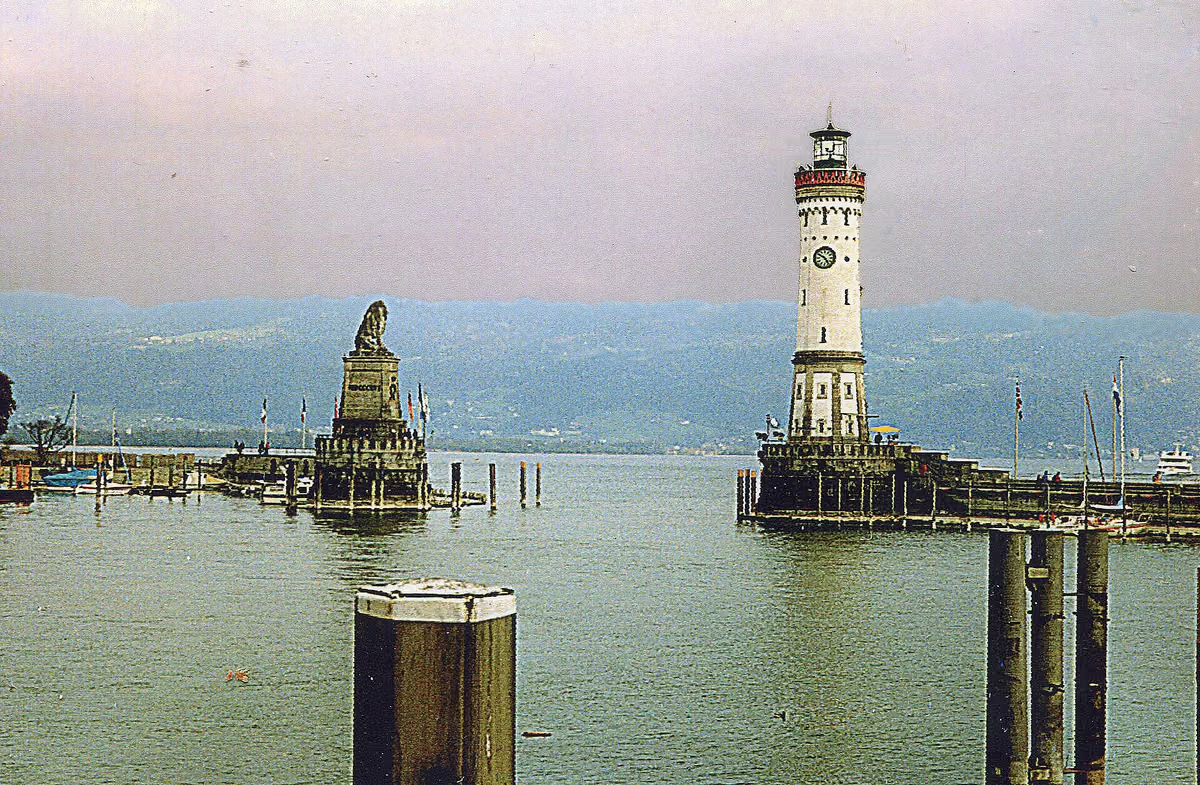
Lindau carries the Bavarian corner's monuments: the island old town reached by causeway, and the famous harbour entrance guarded by the seated Bavarian Lion and the New Lighthouse — Germany's southernmost lighthouse and the only one in Bavaria. The older, stubby Mangturm on the quay is the harbour's medieval watchtower, not the working lighthouse, a distinction worth keeping straight.
Around these set pieces runs a wider monumental shore: Mainau's baroque palace and church amid its gardens, the reconstructed pile dwellings at Unteruhldingen, the Gothic Münster of Überlingen, the Zeppelin Museum at Friedrichshafen, and the Pfänder's terrace above Bregenz — a circuit best understood as one shared landscape rather than three national collections.
- Reichenau: the three Romanesque churches and the UNESCO-listed remains of the island monastery.
- Konstanz: the Minster, the Konzil building on the harbour, the Niederburg lanes, and the Imperia statue.
- Meersburg: the inhabited Altes Schloss and the baroque Neues Schloss above the terraced vineyards.
- Lindau: the island old town and the harbour with the Bavarian Lion and the New Lighthouse.
- Mainau: the baroque palace and church at the heart of the flower island.
- Unteruhldingen and Friedrichshafen: the pile-dwelling museum and the Zeppelin Museum on the northern shore.
The lake, the islands, and the mild climate
The lake is the landscape's fixed fact: a great sheet of water, deep and cold in its main basin, that stores the Rhine and moderates everything around it. It supplies drinking water to millions in southern Germany, carries the white-fleet ships between the towns in the warm season, and gives the region its mild, moist air — the reason vines and orchards thrive this far north.
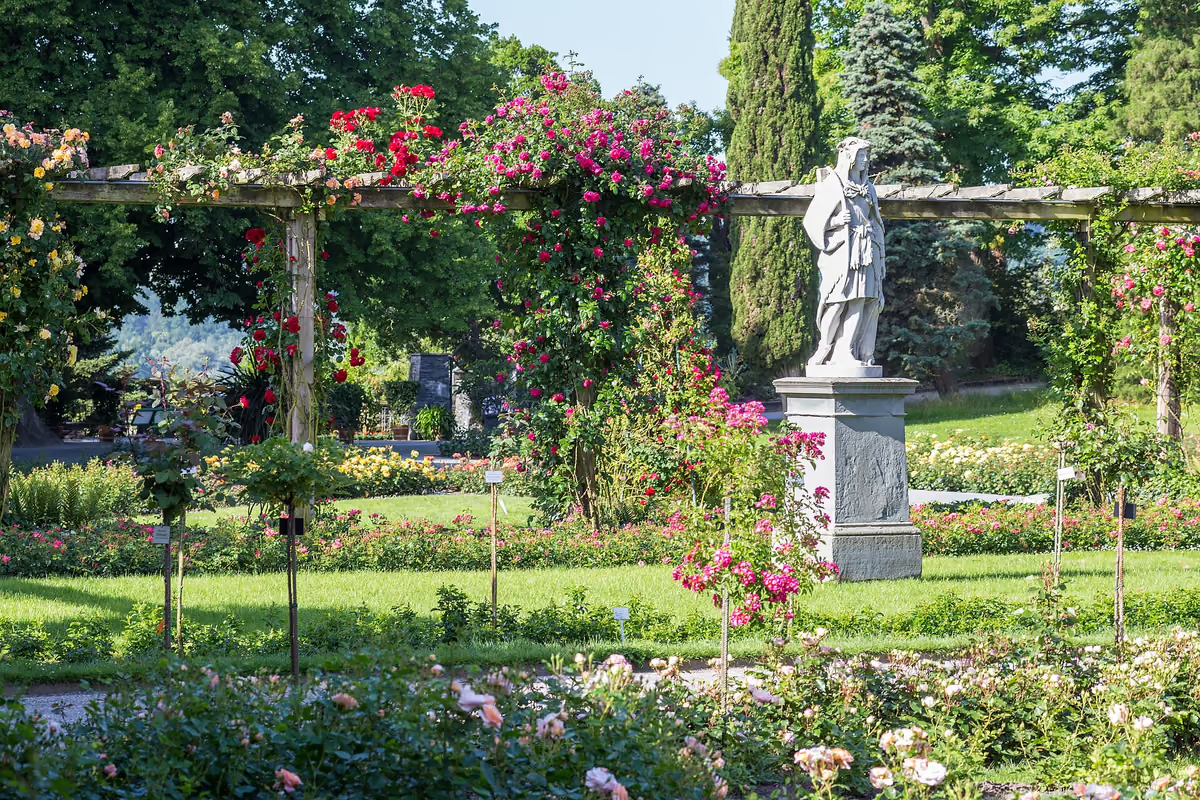
The two garden islands are the lake's signature. Mainau, reached by a footbridge from the Bodanrück shore, is the Flower Island: a private garden estate run by the Bernadotte family, where spring bulbs, summer perennials, and an autumn blaze of dahlias follow each other around a baroque palace and a butterfly house. Reichenau, joined to the mainland by a causeway, is its opposite and its complement — the monastic island that is also a working 'vegetable island', its flat fields under glass and open sky feeding the region.
The quieter water has its own richness. The shallow Untersee and the reed belts of the Wollmatinger Ried and the Höri are among the most important bird habitats in Central Europe, alive with migrating and wintering waterfowl, and the western end of the lake shades into the gentler Hegau with its volcanic cones.
Beyond the shore, the Alps frame the south: the Säntis and the Appenzell mountains rise across the Swiss water, and the Pfänder above Bregenz gives the classic high view back over the whole lake. The Bodensee keeps its high mountains at arm's length — near enough to fill the horizon, far enough to leave the shore itself mild, cultivated, and walkable.
Local culture and way of life
Daily life on the Bodensee runs on the water and the seasons. In summer the shore lives outdoors — swimming, sailing, the promenades, the cycle path, the evening boats — and in winter it turns quiet and inward, with the ships largely laid up and the towns handed back to the people who live in them. It is a real region with universities, industry, and farms, not only a holiday backdrop.
The border is woven into ordinary life. People shop across the line in Kreuzlingen or Konstanz, commute between countries, and treat three national habits — German, Swiss, and Austrian — as normal. For the visitor this means a lake that is easy to cross but worth understanding: prices, customs, and even the feel of a town shift as you pass from one shore's country to another.
The food culture is a mild-lake cuisine: Felchen and other lake fish, the local Seewein, orchard fruit and cider, asparagus in spring, and the hearty southern-German and Swiss cooking of the shore towns. It is regional and seasonal rather than grand, at its best in a harbour-side inn with the water a few metres away.
The lake also carries a cosmopolitan, cultivated layer that surprises first-time visitors: the summer festival crowds at Bregenz, the garden pilgrims to Mainau, the cyclists working their way around the whole shore, and the students and scientists of Konstanz. An evergreen guide does not need the events calendar; it needs to hold all of this inside one honest idea — a single lake, cultivated and mild, lived in by three countries at once.
The guide moves from the open water to the shores, islands, and borders.
Lake Constance is treated as a cultural landscape, not a checklist of viewpoints: the tri-national water, the pilgrim and monastic faith of the islands, the soft border shared by three countries, and the mild garden climate shape the region together.
One lake, three countries
For most of the lake, the national boundary has never been legally fixed, and Konstanz runs straight into Swiss Kreuzlingen while Lindau sits beside Austrian Bregenz. The Bodensee is a single region cut by three national edges, and reading it that way is the key to it.
The Rhine's wide place
The Rhine fills the lake from the Alps and leaves it at Konstanz, splitting the water into the open Obersee and the quiet Untersee. The lake stores drinking water for millions and spreads the mild, moist climate that lets vines and orchards grow.
The monastic island
Reichenau's abbey, founded in 724, was one of the intellectual centres of the early-medieval West. Its three Romanesque churches and the memory of its scriptorium earned the island a UNESCO World Heritage inscription in 2000.
The council town
Between 1414 and 1418 the Council of Constance ended the schism of rival popes and made Konstanz briefly the centre of Latin Christendom — and burned the reformer Jan Hus in 1415, a history the town states plainly.
The cultivated shore
Terraced vineyards above Meersburg, orchards in spring blossom, the flower island of Mainau, and the market gardens of Reichenau make the Bodensee a garden lake — mild, worked, and green — rather than a wild Alpine one.
Use the cultural reading to make better trip decisions.
The practical articles cover which shore and town to sleep on, how to reach the islands of Mainau and Reichenau, how the ferries and BSB ships work, arriving via Zürich, and cross-border day-trips into Switzerland and Austria.
Where to stay on Lake Constance: five useful base towns
Compare Konstanz, Meersburg, Lindau, Friedrichshafen and Überlingen by location, transport and the places you want to visit.
Getting to and around Lake Constance
Plan rail and air arrivals, BSB passenger boats, the year-round car ferry and catamaran, and the 260-kilometre Bodensee-Radweg.
Mainau and Reichenau: gardens or World Heritage
Compare Mainau's ticketed gardens with Reichenau's three Romanesque churches, including current access checks and realistic transport planning.
Lindau and Meersburg: plan the towns separately
Plan Lindau's island harbour and Meersburg's two castles, understand the car-ferry geography, and verify seasonal boat routes before combining them.
Day trips from Lake Constance into Switzerland and Austria
Plan the Rhine Falls, Stein am Rhein, Bregenz, the Pfänder and St Gallen with accurate travel-document and Swiss motorway-vignette guidance.
When to visit Lake Constance
Choose a Lake Constance season by garden displays, route-dependent boat services, cycling conditions and verified 2027 Bregenz Festival dates.
Official sources hold the current facts.
This guide is cultural and evergreen. Ferry and boat timetables, garden seasons, tickets, transport, and opening details are intentionally left to the official operators.
- Internationale Bodensee TourismusThe official cross-border tourism board for the whole lake region: shore-by-shore framing, the passenger-boat network, the Bodensee-Radweg, and events across Germany, Switzerland, and Austria.
- Konstanz TourismKonstanz destination context: the Niederburg old town, the Council of Constance history, the harbour and Imperia statue, and current visitor information for the largest lakeside town.
- Insel MainauCurrent year-round visitor access to Mainau, opening information, tickets, and seasonal changes to its gardens and attractions.
- Reichenau TourismCurrent visitor access to Reichenau's three Romanesque churches, including the conservation restrictions at St Georg.
- UNESCO — Monastic Island of ReichenauThe World Heritage inscription (List No. 974, inscribed 2000) for the Monastic Island of Reichenau and its Benedictine monastery and churches.
- Lindau TourismLindau destination context: the island old town, the harbour with the Bavarian Lion and the New Lighthouse, the Mangturm, and current visitor information for the Bavarian corner of the lake.
- Stadt MeersburgMeersburg context: the Altes Schloss and the baroque Neues Schloss, the terraced vineyards and lakefront, and current visitor and event information.
- Bodensee-Schiffsbetriebe (BSB)Current route-specific timetables for the scheduled BSB passenger ships and links to the operator's 2026 timetable downloads.
- Bregenzer FestspieleThe 2027 Seebühne production of La traviata, with performances from 22 July to 22 August; the festival as a whole begins on 21 July.
- Deutsche BahnCurrent rail connections along the German shore and to Zürich, Munich, and Stuttgart, timetables, and tickets.
- The lake’s namesBodman as the origin of Bodensee and Konstanz as the origin of Lake Constance.
- Lake Constance boundariesThe absence of a legally fixed national boundary across most of the lake and cross-border surveying cooperation.
- Obersee whitefish reportThe 2024–2026 whitefish closure and the distinction between fishing tradition and current catch.
- Whitefish: decision for 2027The June 2026 decision for limited, monitored reopening in 2027.
- Burg Meersburg: Old CastleThe Old Castle’s own visitor information, history and event programme.
- New Palace: opening calendarThe separate New Palace operator’s seasonal opening and winter closure calendar.
Use this culture guide with the practical articles
Continue with the practical articles for choosing a base, checking island access, understanding the separate boat operators and planning a cross-border day. Wider Germany travel information is at premiergermany.com.